23 September 2026
By Dr. Ashutosh Das Sharma
Radiation Therapy Before It Starts: From Planning to the First Session
Other Blogs

Cancer Treatment Second Opinion: When, Why and What to Ask
9 September 2026
Prostate Cancer Screening Guidelines for Men Over 50
23 August 2026
यह ब्लॉग हिंदी में भी उपलब्ध है
What Happens Before Radiation Therapy Starts?
Starting radiation therapy involves more than simply arriving at the treatment machine. Before the first session, your radiation oncologist and radiation therapy team plan how radiation will be delivered so the intended treatment area can receive the prescribed dose while nearby normal tissues are protected as much as possible.
For external beam radiation therapy, the process commonly includes consultation, simulation, treatment planning, safety and quality checks, and then treatment delivery. The exact steps vary with the cancer type, treatment area and technique.
1. Radiation Oncology Consultation
The first step is a detailed consultation. Your radiation oncologist reviews your diagnosis, pathology, scans, previous treatment, medical history and why radiation therapy is being considered.
- What is being treated? The team identifies the cancer or treatment area and reviews the available imaging and pathology.
- Why radiation therapy? Radiation may be recommended before or after surgery, with other cancer treatments, or to control symptoms, depending on the individual situation.
- What approach is appropriate? The technique, dose and schedule are selected for the individual patient.
- What should you expect? Your doctor can discuss the intended benefit, possible side effects, preparation and follow-up.
2. CT Simulation — Your Treatment Planning Session
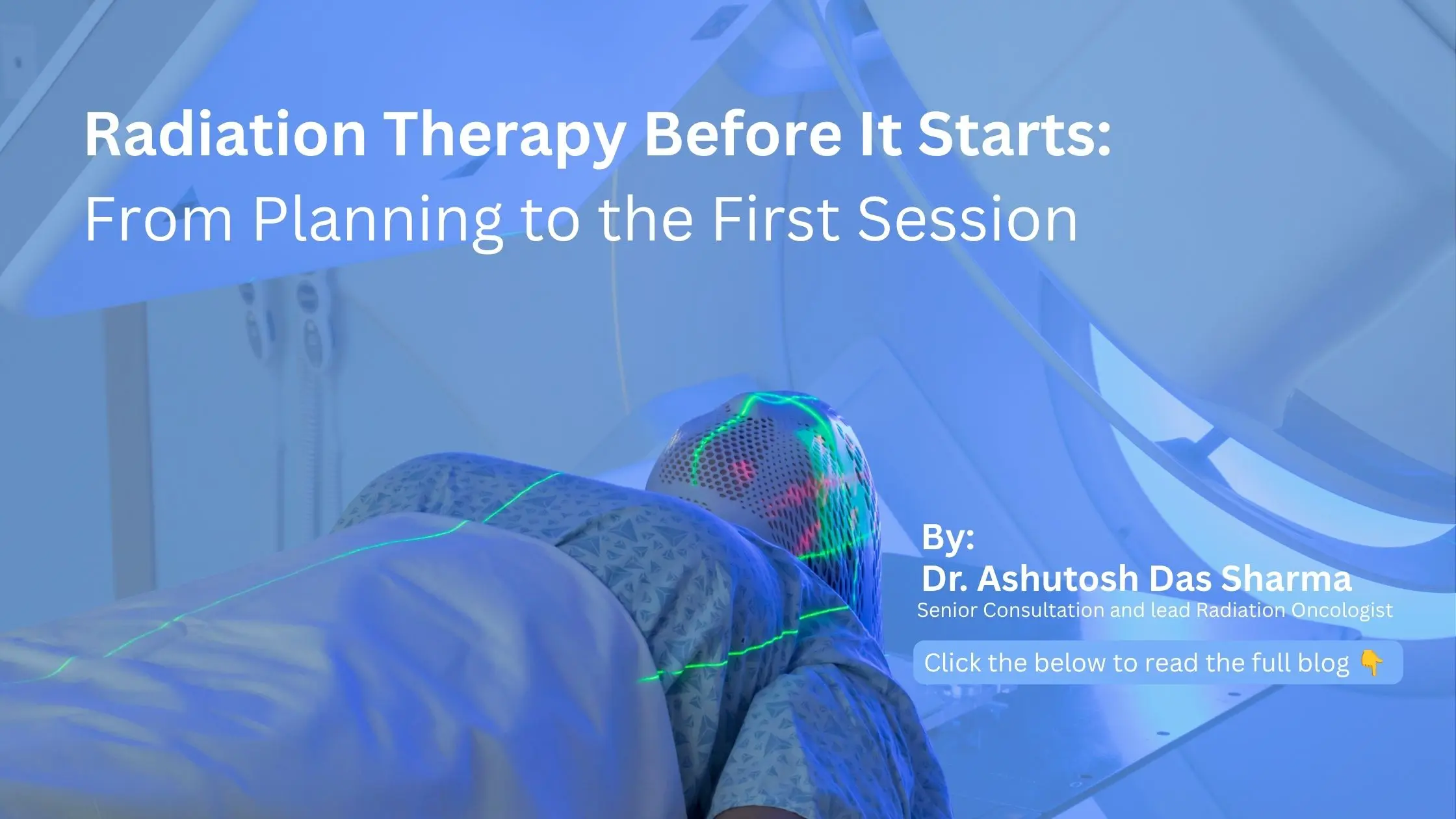
Once radiation therapy is planned, you may be scheduled for a simulation. This is a dedicated planning appointment, not the actual radiation treatment. You are positioned in the way the team expects you to be positioned for treatment, and planning images are obtained.
CT simulation is commonly used for external beam radiation therapy. Depending on the cancer and treatment technique, MRI, PET/CT or other imaging information may also be incorporated into planning.
3. Positioning, Masks and Immobilization Devices
Accurate positioning matters because the planned setup needs to be reproduced from one session to the next. Depending on the treatment area, the team may use a custom mask, body mould, cushion or other positioning support to help you remain in the planned position.
Small skin marks may also be used as alignment references. Some marks are temporary; tiny permanent tattoo marks may be used in some treatment plans. Your team will explain what is needed for your particular treatment.
4. Treatment Planning — Dose, Target and Nearby Organs
After simulation, the radiation oncologist defines the areas that need treatment and the nearby organs or tissues that need to be protected as much as possible. A team that can include the radiation oncologist, dosimetrist and medical physicist uses specialised software to develop and check the treatment plan.
Techniques such as 3D conformal radiation therapy, IMRT, VMAT, IGRT or other specialised approaches may be used when appropriate. The choice depends on the cancer, target location, treatment goal and available technology.
The prescribed radiation dose may be divided into fractions. The number and frequency of sessions are individualised. Many conventional external beam treatments use a weekday schedule, but shorter or different schedules may be appropriate in selected situations.
5. Quality and Safety Checks Before Treatment
Radiation treatment plans undergo checks before the first treatment is delivered. The purpose is to make sure the prescribed radiation can be delivered as intended. Depending on the technique, imaging may also be used immediately before or during treatment to verify positioning.
This is one reason there may be a gap between simulation and the first treatment session. The planning and verification process is an important part of radiation therapy.
6. What Happens During the First Radiation Therapy Session?
On the first treatment day, you may be asked to change into a gown depending on the treatment area. The radiation therapist helps you onto the treatment table and reproduces the position used during simulation.
- Positioning: Your marks, mask or other positioning device are used to reproduce the planned setup.
- Verification: Treatment-room imaging may be performed to check alignment.
- Treatment: The machine delivers the prescribed radiation from planned directions. The machine does not need to touch you.
- Communication: The therapist monitors you and can communicate with you. Tell the team if you are uncomfortable or need help.
The first visit can take longer than later sessions because positioning, imaging and final verification may require additional time. The actual radiation delivery is often much shorter than the total time spent in the treatment room.
7. What Should You Do Before Your First Session?
Your preparation depends on the treatment area and the specific plan. Follow the instructions given by your radiation therapy team rather than using a generic routine.
- Bring your treatment documents and information about medicines or supplements when requested.
- Follow any instructions about food, hydration, bowel or bladder preparation if your team has given them.
- Wear comfortable clothing unless your centre has provided different instructions.
- Avoid applying products to the treatment area unless your team has told you they are appropriate.
- Tell the team about new symptoms, medicines, allergies, pregnancy or a possibility of pregnancy when relevant.
- Ask what to expect on the first day and how long you should allow for each visit.
8. Questions to Ask Before Radiation Therapy Begins
You do not need to remember everything on the day of consultation. Writing down your questions can make the discussion easier.
- What is the goal of radiation therapy in my case?
- Which area will be treated?
- How many sessions are planned, and how often will they be given?
- Will I need a CT simulation, mask, mould or other preparation?
- Do I need any special food, hydration, bowel or bladder preparation?
- What side effects are most relevant to the area being treated?
- Whom should I contact if I have a problem during treatment?
A Simple Radiation Therapy Timeline
- Consultation → diagnosis, scans, previous treatment and treatment goals are reviewed.
- Simulation → your treatment position and planning images are obtained.
- Planning → the radiation dose distribution and treatment technique are developed.
- Verification → the plan and setup undergo the required checks.
- First session → your planned position is reproduced and verified, and the prescribed treatment is delivered.
- Subsequent sessions → the carefully planned setup is reproduced, with monitoring and adjustments when needed.
For Patients in Raipur and Chhattisgarh
If you are starting radiation therapy in Raipur, keeping your pathology reports, scan reports and imaging files, previous treatment records and current medicines organised can make consultation and planning easier.
At American Oncology Institute–BCR Hospital, Jora, Raipur, a radiation oncology consultation can help patients understand whether radiation therapy may have a role in their individual cancer, what the planning process involves and what to expect before treatment begins.
The exact treatment technique, dose, number of sessions and preparation are individualised according to the diagnosis, stage, treatment goal, treatment area and overall clinical situation.
Quick Checklist Before Your First Radiation Session
- Keep your pathology and scan reports accessible.
- Carry previous treatment records if requested.
- Know your current medicines and supplements.
- Follow any treatment-specific food, hydration or bowel/bladder instructions.
- Follow any clothing instructions for the treatment area.
- Write down important questions before the appointment.
- Ask whom to contact if you develop a concern during treatment.
Frequently Asked Questions
What is a CT simulation for radiation therapy?
A CT simulation is a planning appointment used to map the treatment area and establish the position in which radiation will be delivered. It is not the same as the actual radiation treatment.
Does everyone need a CT simulation before radiation therapy?
Many external beam radiation therapy plans use CT simulation, but the exact planning process depends on the cancer, treatment area and technique.
How many radiation therapy sessions will I need?
The number of sessions depends on the cancer type, stage, treatment goal, target area, prescribed dose and radiation technique. There is no single schedule for every patient.
What happens during the first radiation therapy session?
The radiation therapist reproduces the planned position, uses the simulation marks or positioning devices, performs any required verification imaging and then delivers the prescribed radiation.
Is the first radiation therapy session painful?
External beam radiation treatment itself is generally not felt. Staying in position or using an immobilization device can be uncomfortable for some patients.
Do I become radioactive after external beam radiation therapy?
No. External beam radiation therapy does not make you radioactive. Instructions can differ for some forms of internal radiation therapy.
What should I do before my first radiation session?
Follow the treatment-specific instructions given by your radiation therapy team. Depending on the treatment area, this may include instructions about food, hydration, bowel or bladder preparation, clothing or skin products.
Medical Information Sources
This article is an educational guide and does not replace an individual medical consultation. General information about external beam radiation therapy, simulation, treatment planning, positioning and treatment sessions is based on patient information from the National Cancer Institute, the American Cancer Society and RadiologyInfo.org.
The Message
"Radiation therapy does not begin with the machine. Careful consultation, simulation and planning come first—so that treatment can be delivered as precisely and safely as possible."
Ask questions, understand your preparation instructions, and know what to expect before your first session.
— Dr. Ashutosh Das Sharma, Radiation Oncologist, AOI-BCR, Jora, Raipur